How Long Does Window Film Take to Cure?
Hazy film, water pockets, blotchy glass right after installation? That is curing. Here is what is normal, how long each film type takes, and what not to do.

How Long Does Window Film Take to Cure?
The installation is done, the crew has packed up, and you walk over to admire your new window film — and it looks... cloudy. Maybe a little milky. Maybe there are a few bubbles under the surface.
Before you call anyone: this is almost always completely normal. Window film goes through a curing period after installation, and what you are seeing is part of the process, not a defect. Here is what is happening, how long it takes, and what you should (and should not) do while it dries.
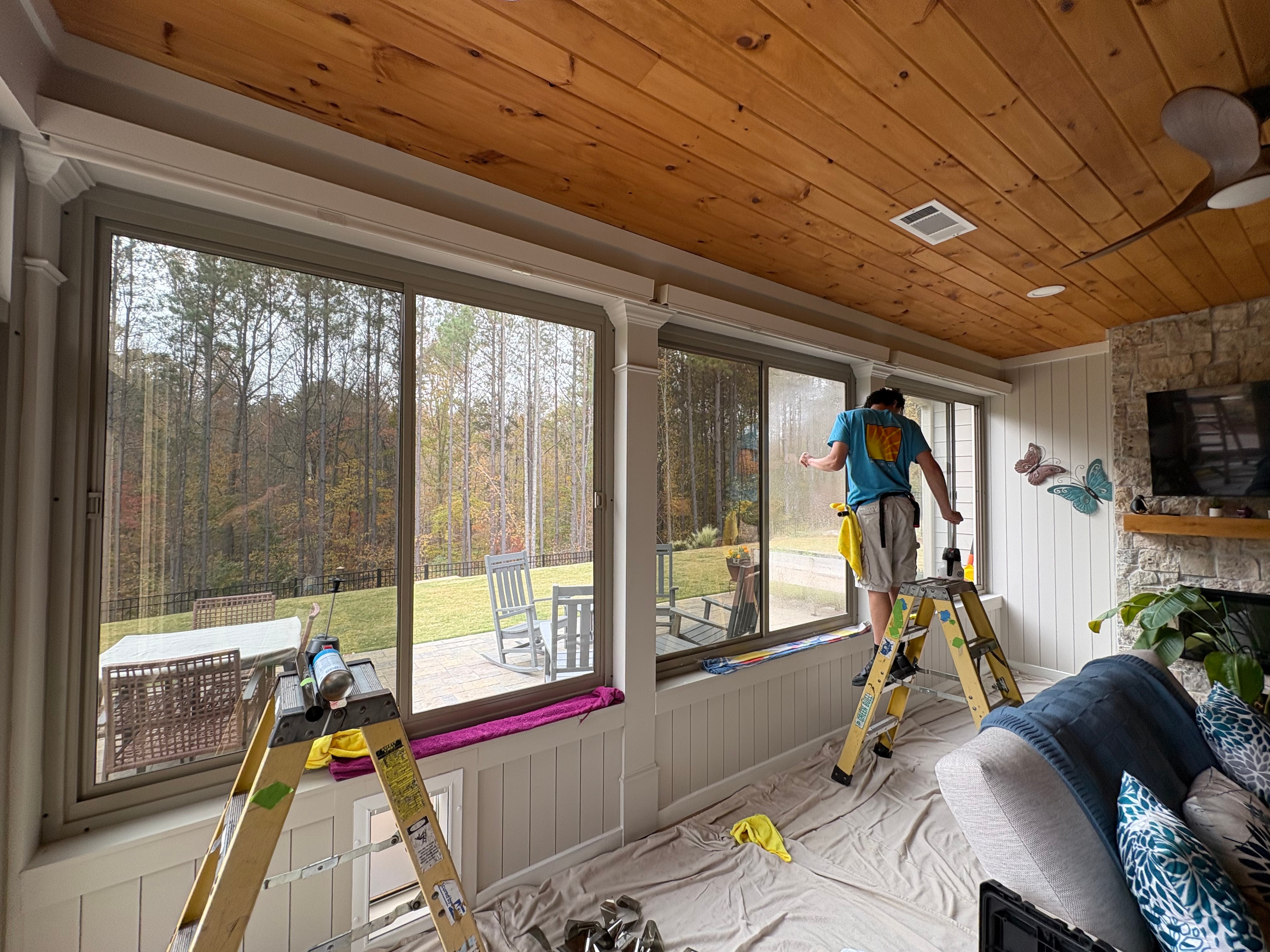
Recent Sungate job: floor-to-ceiling sunroom glass freshly filmed in Canton, GA. Film like this goes on wet and needs time to dry out and fully bond.
Why Window Film Needs Time to Cure
Professional installers apply window film wet. A mounting solution (sometimes called slip solution) is sprayed on the glass so the film can be positioned accurately, then squeegeed out from under it.
Even after a thorough squeegee job, a thin layer of that moisture remains trapped between the film and the glass. Over the following days and weeks, that moisture slowly evaporates through the film itself while the adhesive completes its bond to the glass. That dry-out period is what installers call curing.
Here is the part most people miss: the film starts working immediately. Heat rejection, UV protection, and glare control are all active from day one. Only the optical clarity improves over time as the moisture leaves.
What Is Normal During Curing
All of the following are caused by that residual moisture scattering light — and all of them resolve on their own:
- A milky, hazy, or cloudy look — the most common early sign of curing, especially in the first few days
- Blotchy or uneven areas — some patches look wetter or darker while moisture leaves the film at different rates
- Water pockets or small bubbles — from pinhead size up to larger spots. These are moisture, not air, and they shrink and disappear as the film dries
- Temporary distortion or streaking — especially when light hits the glass at certain angles
None of these are defects in the film or the installation.
One important warning: do not poke, press, or try to pop water pockets. Disturbing the film during curing can damage it, and that kind of damage is not covered by the warranty.
Typical Curing Times by Film Type
Exact timing depends on weather, glass orientation, and the film itself — but here are realistic expectations:
| Film Type | Typical Cure Time |
|---|---|
| Standard solar-control film | About 30 days |
| Safety and security film | 60 to 90+ days |
| Precious-metal film (Sech & Drei) | A few weeks of visible haze, sometimes longer |
Safety and security films simply take longer because they are much thicker — more material means more moisture to dry out.
The Exception: Precious-Metal Films
If you invested in a high-performance precious-metal film like Huper Optik Select Sech or Drei, expect a longer cloudy phase. These films incorporate gold and/or silver layers, and that dense metallic construction slows the escape of residual moisture.
The result: the film can look blotchy and cloudy for up to a few weeks, and sometimes longer in cooler or less sunny weather. It can be unsettling if you are not expecting it — but it is expected and completely normal for this class of film.
While a precious-metal film cures:
- Be patient. Do not poke bubbles or try to speed the process
- Do not apply uncontrolled heat (like a hair dryer) to the film
- Do not clean early. Wait at least 30 days before the first contact
Once fully cured, Sech and Drei reach their final clear, high-performance appearance — the temporary haze is not a preview of the end result.
What Affects Curing Speed
Curing is mostly a weather story:
- Outdoor temperature — warm weather speeds it up considerably
- Humidity — drier air pulls moisture through the film faster
- Direct sunlight — sun-exposed glass cures faster than shaded glass
- Window orientation — north-facing glass sees little direct sun and cures slowest
- Film thickness — thicker films take longer
In the middle of a Georgia summer, a standard film can look great in two to three weeks. The same film installed in January may still show faint haze a month later. Neither situation is a problem.
Caring for Film While It Cures
The rules are simple:
- Leave the film completely alone while it cures
- Do not clean, wipe, or touch it for at least 30 days. With metalized films, waiting longer is safer
- Never try to pop or disturb water pockets
- Once the recommended period has passed, clean only with soft microfiber cloths and mild, ammonia-free cleaners approved for window film
Ammonia-based cleaners are the big one to avoid — even after curing, they can degrade the film over time.
When to Actually Call Your Installer
So when is something genuinely wrong? If visual issues are still present after the full expected curing window for your film type has passed, that is the time to report it. A fully cured film should be clear, tightly bonded, and free of visible artifacts.
Until then, trust the process. Almost every "problem" call we get in the first month turns out to be normal curing.
Questions About Your New Film?
Sungate Window Tinting has been installing window film across Greater Atlanta for over 33 years — and we are happy to walk you through what to expect after installation, for any film we offer.
Call or text: 678-488-6311 Free estimates — Canton and all of Greater Atlanta
Explore Topics
Written by
Joe Anderson
Content creator and writer sharing insights and stories.
